Abstract
The prevailing assumption in the popular literature on creativity is that the bottleneck is idea generation. This article argues that the bottleneck usually sits elsewhere, in the gap between an idea and its realisation, and offers a proposed taxonomy of four distinct states in which that gap forms: thinking without an external representation, learning instead of doing, output without accumulation, and execution without meaning. Each state is referred to its own independent research literature, from the meta-analysis of implementation intentions and work on cognitive offloading through to the procrastination meta-analysis and the Areas of Worklife model in burnout research. The central argument is that because all four present with the same external sign, they receive the same advice, and that advice serves none of them. A closing section sets out the limits, including that the taxonomy is a proposal rather than a finding and that the four states are not equally well evidenced.
Keywords: intention-action gap, implementation intentions, cognitive offloading, procrastination, fluency illusion, burnout, values mismatch
1. The problem
In the popular literature on creativity the prevailing assumption is that the obstacle is a shortage of ideas. On that assumption, a large part of creativity training addresses idea generation: brainstorming, forced association, inversion, and similar techniques.
The assumption has two difficulties.
First, it does not fit what is known about the mechanism of creativity. In the creative cognition literature, generation is the operation that almost always works; what is limited is the range of material and the order of operations, not the capacity to generate.
Second, if the bottleneck is not in generation, adding more ideas makes things worse, since it adds to a backlog without anything leaving it.
The question here is therefore: if the bottleneck is not generation, where is it, and is it one place or several?
The answer proposed is that it is not one place. There are at least four distinct states that look identical from outside and that have different mechanisms and different interventions.
2. Scope and method
This article does two different things and the distinction matters.
- A review of existing literature. For each state, the relevant research is introduced. These sections rest on peer-reviewed sources and meta-analyses.
- A proposed taxonomy. That these four states should be distinguished, and that these are the four, is the author's proposal and has not been tested in the literature. Section 9 opens that limitation.
The four literatures below do not cite one another and grew up in four separate traditions. What is done here is to place them side by side under one practical question.
3. The frame: the intention-action gap
Before the four states, one general finding is needed, under which all four sit.
The distance between what a person intends to do and what they actually do is a well-established and measured phenomenon in social psychology. What makes it interesting is how the distance is closed.
Gollwitzer and Sheeran (2006), in a meta-analysis of 94 independent tests and more than 8,000 participants, found that forming an implementation intention has an effect of d = 0.65 on goal attainment.
An implementation intention is a specific formulation: "If situation Y arises, I will initiate behaviour X." The where, when and how of acting is settled in advance.
Four functions are reported for it:
- initiating action
- shielding ongoing pursuit from interference
- disengaging from failing courses of action
- conserving capability for later goals
The decisive point here is that the intervention does not manipulate motivation. It manipulates formulation. If the gap between intention and action closes through a change in formulation, then explaining that gap by a lack of motivation or willpower is a weak explanation.
4. State one: thinking without an external representation
The sign. A decision under consideration for months, where the shape of the problem has changed by each return to it. The usual phrase is "I am still thinking about it."
The mechanism. Without a stable external representation, the mind rebuilds the problem on each pass. There is no persistent version to accumulate work on, so each session of thinking reconstructs the previous one rather than continuing it.
The relevant literature. Risko and Gilbert (2016) define cognitive offloading as the use of physical action to alter the information processing requirements of a task and reduce cognitive demand. Note-taking, drawing and setting a reminder are all instances.
The point that explains this state appears in the same review: the propensity to offload depends on a person's metacognitive evaluation of their own abilities, and that evaluation can be wrong. People therefore sometimes offload less than would be optimal, because they have overestimated what they can hold in mind.
Put differently, "I will keep it in my head" is not a stylistic preference. It is a recognised metacognitive error.
What works. Moving the problem into an external representation, even an incomplete one. And at the level of action, the implementation intention of section 3: fixing where and when, rather than adding thinking time.
5. State two: learning instead of doing
The sign. A collection of half-finished courses and materials, together with a standing judgement that what is known is not yet enough.
This state has the strongest research support of the four, from three independent literatures.
First, the fluency illusion. Rereading a text produces familiarity and perceptual fluency that is easily mistaken for understanding; in the learning literature this is called an illusion of comprehension. On that basis Bjork and Bjork propose desirable difficulties: interventions that lower immediate performance and raise long-term retention.
Second, the testing effect. Roediger and Karpicke (2006) measured this with educational prose. Participants studied a passage and then either reread it or retrieved it from memory. On a final test after five minutes, repeated study performed better. On delayed tests, prior retrieval produced substantially greater retention.
That is exactly the pattern of this state: a practice that feels better in the short term and leaves less in the long term.
Third, procrastination. Steel (2007), in a meta-analysis drawing on 691 sources, found the strong and consistent predictors of procrastination to be task aversiveness, task delay, self-efficacy and impulsiveness, along with conscientiousness and its facets. The paper's title states the position: procrastination is a self-regulatory failure.
This finding matters beyond this section. The claim "you are not lazy" has direct empirical support in the case of procrastination. What predicts procrastination is task aversiveness and low self-efficacy, not a trait called laziness.
What does not work. Cutting the volume of learning without replacing it with a small output. The problem is not the quantity of knowledge; it is the absence of any experience of building with that knowledge before feeling ready.
6. State three: output without accumulation
The sign. There is output, and not a small amount of it, but every project starts from the beginning. The marker of this state is exhaustion, not inaction.
The mechanism. The results of the work do not accumulate anywhere. No project makes the next one easier, because the method, tools and knowledge it produced were never recorded and made retrievable.
The relevant literature, and here it must be said plainly: this is the weakest link in the article. No dedicated literature was found for it, and what exists is indirect.
On one side, the same notion of cognitive offloading from section 4, this time in the role of external memory: if method and output are not recorded, each round begins at zero. On the other, two mismatches from the model introduced in the next section, workload and reward: high output with no accumulated return is an instance of both.
This state calls for new research and is offered here with less confidence than the other three.
What does not work. Adding pressure or more discipline. The problem is neither motivation nor ability but the absence of infrastructure: a repeatable method, an archive, and a rhythm that makes the work predictable.
7. State four: execution without meaning
The sign. The work gets done, commitments are met, and nothing looks wrong from outside. What is missing is the relation between the work and what matters to the person.
The relevant literature. This state has a definite place in burnout research. Maslach describes burnout along three dimensions: exhaustion, cynicism, and reduced professional efficacy.
In the Areas of Worklife model, Leiter and Maslach (1999) attribute burnout not to the intensity of work but to mismatch between person and job across six areas:
- workload
- control
- reward
- community
- fairness
- values
A mismatch in a single area can produce burnout; a mismatch across three or more produces it reliably.
The sixth area is a description of exactly this state: the work is done, and what is absent is the relation between the work and the person's values.
What does not work, and this is the most consequential practical point in the article. In this state, adding structure and management tooling raises the speed of travel along a route whose validity has not been reviewed. An intervention that helps in states one and three is harmful in state four.
8. Why the distinction matters
All four states look the same from outside: someone who has ideas and no output.
Because the external form is the same, the advice received is usually the same, and it circles around discipline, persistence and time management. The effect of that single piece of advice differs by state:
- State one: no effect. The problem is cognitive load, not discipline.
- State two: a fresh justification for one more course about discipline.
- State three: added pressure on a system already coming apart.
- State four: an active contribution to burnout.
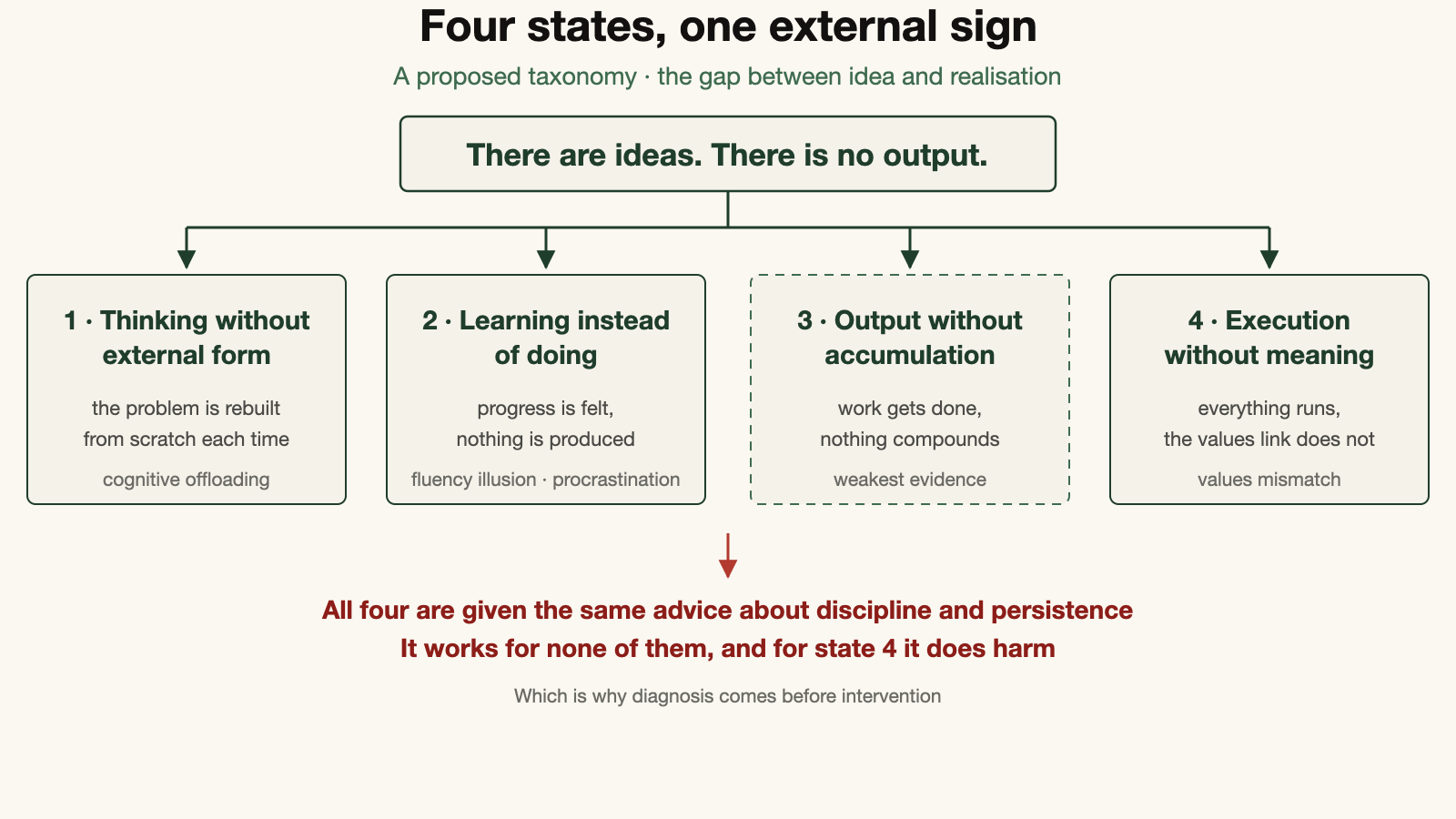
Three conclusions follow.
First, much of what gets read as personal failure is in fact the application of one state's solution to another state's problem. The person applies a sound remedy that is not for their condition, gets no result, and draws a conclusion about themselves rather than about the remedy.
Second, these states can occur in sequence in one person. Resolving state two frequently moves someone into state three. That progression is normal and is not a return to the starting point.
Third, the quality of the idea plays no decisive part in this analysis. In all four states the problem is in transmission, not in the source.
9. Limits
Four limitations should be stated plainly.
First, the taxonomy itself is a proposal, not a finding. No study has tested whether these four states are exhaustive, or mutually exclusive, or whether people occupy one of them stably. What has been done is to place four independent literatures side by side under one practical question. Each literature can be assessed on its own; the division itself cannot yet.
Second, the four states are not equally well evidenced. State two rests on three independent literatures and two large meta-analyses. State four rests on a model established in burnout research. State one rests on a settled concept in cognitive science. State three, as section 6 says, rests on indirect inference. A reader should weight the sections accordingly.
Third, generalisations should stay cautious. The effect size of d = 0.65 for implementation intentions concerns goal attainment in general, not creative work specifically. Likewise, "you are not lazy" is supported for procrastination and does not automatically extend to all four states.
Fourth, diagnosis in practice rests on self-report. A person has to identify which state they are in, and the same metacognitive error described in section 4 threatens that identification too.
10. Implications
- Diagnosis precedes intervention (section 8). Before changing practice, it should be clear which state is running, because the wrong intervention in state four actively does harm.
- Formulation, not motivation (section 3). What closes the intention-action gap is settling where, when and how, with a measured effect size.
- Externalise before adding thinking time (section 4). "I will keep it in my head" is a recognised metacognitive error.
- A small output rather than the next course (section 5). Passive learning feels better in the short term and leaves less in the long term.
- In state four, not more structure (section 7). What is needed is a review of the goal, not an improvement in execution.
11. Conclusion
The common assumption is that the problem in creative work lies in generating ideas. What the literature suggests is that the problem usually lies in the gap between an idea and its realisation, and that this gap is not one state.
The taxonomy proposed here distinguishes four: thinking without an external representation, learning instead of doing, output without accumulation, and execution without meaning. All four present with the same external sign and for that reason receive the same advice, which works for none of them and harms one.
The taxonomy itself has not been tested and is offered as a working hypothesis. What has been tested is the literature behind each state.
The first move, therefore, is not to correct the state. It is to identify it.
References
Bjork, E. L., & Bjork, R. A. (2011). Making things hard on yourself, but in a good way: Creating desirable difficulties to enhance learning. In M. A. Gernsbacher, R. W. Pew, L. M. Hough, & J. R. Pomerantz (Eds.), Psychology and the real world: Essays illustrating fundamental contributions to society (pp. 56–64). Worth Publishers.
Gollwitzer, P. M., & Sheeran, P. (2006). Implementation intentions and goal achievement: A meta-analysis of effects and processes. Advances in Experimental Social Psychology, 38, 69–119.
Leiter, M. P., & Maslach, C. (1999). Six areas of worklife: A model of the organizational context of burnout. Journal of Health and Human Services Administration.
Maslach, C., & Leiter, M. P. (1997). The truth about burnout. Jossey-Bass.
Risko, E. F., & Gilbert, S. J. (2016). Cognitive offloading. Trends in Cognitive Sciences, 20(9), 676–688.
Roediger, H. L., & Karpicke, J. D. (2006). Test-enhanced learning: Taking memory tests improves long-term retention. Psychological Science, 17(3), 249–255.
Roediger, H. L., & Karpicke, J. D. (2006). The power of testing memory: Basic research and implications for educational practice. Perspectives on Psychological Science, 1(3), 181–210.
Steel, P. (2007). The nature of procrastination: A meta-analytic and theoretical review of quintessential self-regulatory failure. Psychological Bulletin, 133(1), 65–94.